


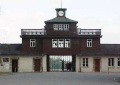
internment of my Opa Karl Pfifferling and his older brother, Julius, at the Buchenwald Concentration Camp.
I have received communication from Sabine Schwab of Bern, Switzerland concerning the internment of my Opa Karl Pfifferling and his older brother, Julius, at the Buchenwald Concentration Camp. Actually, there is not much new information, as we know Opa Karl was released, while Julius was shot to death. I will copy and paste in the original German, followed by the translation to English the portion of the e-mail that is about them.
Laut Veränderungsmeldung vom 16. Mai 1938 wurde Julius Pfifferling, geb.
am 21. Juni 1883 in Wanfried, am 16. Mai 1938 “auf der Flucht erschossen”.
Er hatte die Häftlingsnummer 2870 und war in Block 25 untergebracht.
Karl Pfifferling hatte die Häftlingsnummer 23354. Er wurde am 11. November
1888 (wahrscheinlich aus Halle) nach Buchenwald verbracht. Am 1. Dezember
1938 wurde er entlassen.
Please note, the translation of Pfifferling to English is Chanterelle. Also, where you see transmitter, that is the translation for Sander Pfifferling.
According to the report of change of 16 May 1938 was Julius Chanterelle, born on 21 June 1883 in Wanfried, 16 May 1938 “on the run shot.” He had the prisoner number 2870 and was housed in block 25th
According to the report of change of 16 May 1938 waKarl Chanterelle had the prisoner number 23354th He was brought on 11 November, 1938 (probably from Halle) transported to Buchenwald. On 1 December. In 1938 he was dismissed.
I have received some more information from Sabine Schwabb on the arrest in April. 1938 and the death in May, 1938 of Julius Pfifferling. Also the “Arbeitsscheu Reich” action and the conditions in the Buchenwald Cocentration Camp are detailed. I also want to mention that Thomas Beck has corrected some of the translation.
1. Julius Chanterelle excerpts from ” Lifelines – memories of the families Gembicki / Kemlinski and Schwab ” editorial Sabine Schwab (as June 2, 2013 ) Josef / Julius ( named Jule ) Chanterelle (born 1883) was the second brother of seven siblings . The Chanterelle family came from Wanfried near Eschwege / Hessen and operational before the turn of the century in Halle / Saale a cattle business in the Franckestr . 17. In 1888 the family lived there in Martinsgasse 24. The four sons led the cattle business after the death of his father transmitter Chanterelle ( 1846-1900 ) continued . Parents Chanterelle are both in the Jewish Cemetery in Halle / Saale , Humboldstr . bury
Julius Chanterelle engaged with his brother Adolf in the team of the horse dealer in central Germany. 1929 took over Julius chanterelle the position of vice chairman and cashier. The Association of horse traders in central Germany was founded on 12 December 1918 Vereinslokal Hohenzollernhof in Halle / Saale, Magdeburger Straße 65,. The purpose of the association was “aware of common interests of its members in business matters”, that is the “support of the returning from the field horse dealer, preserving the existing rights of the horse traders, the improvement of insurance and transport systems through mutual interest group, the support of needy widows and orphans on the death of a member, teaching and promotion of its members meeting and Council grant in legal and technical affairs and the closer union of the members and their families by social gatherings. ” The association also adopted a “Rules of Arbitration for all disputes that result, purchasing, exchange or other legal transaction, which refers to horses, arise” can.
Presumably the club foundation was also associated with the Empire Shopping founded during World War I (later the Central shopping company CPB) and the new Reich Ministry of Food and Agriculture. Since August 1916 also was the Reich Commissariat of transitional economy and dealt with questions of influence of the state in the economy after the war (the transition from a wartime to a peacetime economy: reintegration of soldiers, capital formation by lending professions, foreign trade and supply of raw materials). So themed Walther Rathenau (1867-1922) in his text “The new economy” in early 1918, the post-war society no longer condescendingly by the iron hand of the state (in allusion to Otto von Bismarck), but from the bottom through a network of commercial organize and professional associations (self-determination and self-government) -. As “scriptorium” Schwab Viehhandlung were the offices of Messrs. Used. 1922, an employee of Gebr. Schwab Viehhandlung ( “Miss”) the paperwork of the association outside derGeschäftszeiten and received compensation plus an allowance for further currency devaluation (inflation). 1924 was one of the club 142 members. 1926 Premise in Turmstraße 157 was established and set an employee. The chairman of the association of the foundation in 1918 until its dissolution in 1933 was the horse-dealer Max Grunsfeld (1865 to 1936) from Halle / Saale. He was last elected in February 1933rd
In October 1933 , the association be Premise Turmstraße 157 was ” a result of co-ordination ” and withdrew its activities . The dissolution of the association was checked by the police in November 1933 and held in a ” Revier report to the Chief of Police .” After the Reich Association of German horse trader in 1933 , ” integrated ” into the newly formed ” National Federation of the national livestock trade ” as a subdivision , occurred in July 1933 in Magdeburg to a reestablishment of a ” Central German Association of horse trading ” . A few years later , the exclusion of the Jews followed from the National Association and in January 1937, the prohibition of non- German origin Drover
After the end of World War I , the family Chanterelle met several major blows . The elder brother Adolf and his wife Therese Chanterelle , a cousin of the also active in Halle / Saale Jewish cattle dealer Julius Schwab had ,
2. Zwei sons Albert ( born 1904 ) and Hans Ludwig (born 1910) . Albert was accidentally shot in the age of 14 during a street battle on January 12, 1919 a week before the empire-wide election for the German National Assembly . The boy crossed the Riebeckplatz ( close to the station , on the Franckestraße , Merseburger Straße and Delitzscher road running ) and was targeted by a person sitting on a house roof Communists . The newspaper ” Hallesche News ” reported on January 16, 1919:
” An innocent victims of the riots in Halle , the 14 year-old high school student Albert Chanterelle from Franckestraße who was killed on Sunday afternoon in the shootings at Riebeckplatz afternoon was buried in the Israelite cemetery yesterday . The ceremony , which was opened by a conventional manner with a solo singing of the cantor of the community , attended by numerous members of the local Jewish community as well as a representative of the teachers and pupils of the city grammar school (see chapter 4.2 . ) Part . In his poignant eulogy which remained free of any charge , drew Rabbi Dr. Kahlenberg a heartrending image of innocent young men, a treacherous fate had snatched away from a thriving life . The cemetery was during the celebration under military protection . “
On the day of the funeral of Albert chanterelle the suppression of the Spartacus uprising ( general strike and armed struggles ) of Reichswehr soldiers ( Free Corps ) were murdered in Berlin Rosa Luxembourg and Karl Liebknecht in the course . https://en.wikipedia.org/wiki/Spartacist_uprising
Eight years later died Adolf Chanterelle few days before his 49th birthday in 1927. His wife Therese wrote on behalf of their children and other relatives in their Thanksgiving , which appeared in the weekly newspaper for the synagogue district Halle / Saale :
From deep compassion reflected by the countless letters that have been received by us in our misfortune days . We thank each one intimately for it. “
“Only four months later, in August, Therese also lost her little daughter Anna-Kate. The daughter had been born two years after the death of his son Albert 1921st Shortly before their enrollment, the six year old had made with her mother in an English seaside resort holiday. Back in Halle / Saale ill daughter to polio (poliomyelitis, a vaccine was found only in 1960) and died. 14 months later, in October 1928 died Therese Chanterelle in Würzburg / Lower Franconia (Bavaria). Son Hans Ludwig was an orphan and emigrated in 1933 at the age of 23 years alone in the USA. After 1945 he attended as an American soldier Halle / Saale.
In April 1933, the boycott turned “German does not buy from Jews!” And to the cattle business chanterelle. 1933 cattle business Chanterelle was excluded from the newly established “Mitteldeutsche club horsedealing”. 1937 chanterelle brothers were affected by the prohibition of non-German origin Drover. The brothers Julius and Karl Chanterelle presented their cattle business a (brother Adolf was 1927 deceased). In April 1938, thirteen Jews Halle (men) as “Aso prisoners” taken to the Buchenwald concentration camp (“ASR-action”). Including the Drover Julius was Chanterelle. Three of the thirteen men, including a bakery and a hairdresser products wholesaler should not survive their stay in the concentration camp.
3 “Aso” meant in Nazi meaning “asocial” and defined a person “by Community anti- even if not criminal behavior showed that she does not want to fit into the community and to the self-evident in a Nazi state order does not want to add.” The action “Arbeitsscheu Reich” (ASR) took place in two waves of arrests (April and June 1938) and was planned in the personal staff of Heinrich Himmler. The arrests were carried out by the Gestapo and criminal police as a “… comprehensive and surprising access”. The aim of the action was to give the expulsion of Jews from Germany with terror emphasis. It focused on the big cities, had fled to the Jews from the province to find protection with the local communities and charities, which was seen as an expression of “Jewish insolence”. The second wave took place in July 1938 prior to the conference in Evian. News from the terror against the Jews should promote the receptiveness of German Jews abroad. The police returned to the end of 1945 a total of 70.000Menschen as “criminals and anti-social elements” in the concentration camps, of which about half was murdered there.
Julius Chanterelle received in Buchenwald prisoner numbers 2870 and had to work in a quarry. Three weeks later he was at the age of 54 years in the direction of the electric barbed wire. Even before he reached the barbed wire, he was “shot while escaping”. It was also reported that he had been killed after the escape of two prisoners from retaliation. He was the second Hallenser Jew who was murdered in Buchenwald. The case also dealt with the Central Association of German Citizens of Jewish Faith, who had already become aware of the cooperation of Gestapo and employment offices at the arrests in Halle / Saale.
On 10 November 1938 Opa Karl was arrested and interned at Buchenwald.
The Buchenwald concentration camp near Weimar was operated between July 1937 and April 1945 as a labor camp. The camp gate bore the inscription “To each his own”, which about 250,000 people were war.Insgesamt to read the roll call area of imprisoned from all European countries in the Buchenwald concentration camp. The death toll is estimated at around 56,000. In April 1938, a mass arrest and introduction of so-called “work scrubbing”. The first public execution of a prisoner by hanging took place in June 1938 statt.Im November 1938 9,845 Jews were arrested in order to extort their departure. The living conditions in the “Jewish camp” (a special camp within the concentration camp) were particularly bad, so in the first few weeks, over 200 people died. There was no water for drinking and for washing, food, medicines and the most basic sanitation facilities (toilets, soap and toilet paper). After arriving on 10 November had thousands of people all night standing on the parade ground and there relieve oneself. On the fourth day there was the first meal of the prisoners got diarrhea. The soiled clothes could neither changed nor cleaned. There was crowding in too small lodging (five barn-like barracks). When it rained, the soil turned into ankle-deep mud that pulled the shoes off. In February 1939brach typhoid and in November 1939 from Ruhr. At the end of the war Buchenwald is the largest concentration camp in the German Reich. When the Americans reached Buchenwald and its satellite camp in April 1945, wrote Dwight D. Eisenhower, the supreme commander of the Allied Forces and later President of the United States:”Nothing made me ever so shaken as this sight.”
Police in Halle brought the chanterelle family the urn containing the ashes of Julius chanterelle. The niece Hildegard (1922 by 2008 and daughter of Karl chanterelle) later recalled this moment: “It was very sad. He (Julius) and his wife Dora (Dorothea, born 1886) had no children. My uncle was always very dear to me and brought me candy, toys and other things. He was a very kind and gentle man … loved to play cards with some of his friends in a nearby pub. Often, if the customer, in our 4Geschäft came and asked for “Jule”, I walked him (there) pick and brought him home. “The widow of Julius Chanterelle Dorothea (born 1886) later emigrated to England.
Sources: Life Data Stadtarchiv Halle / Saale Winkelmann, Volkhard and former students project “Jews in Halle” of Südstadt- Gymnasium: Our memorial book for the victims of the Holocaust in Halle, Halle / Saale 2008 (3rd edition), http://www.gedenkbuch.halle.de the seed box family / Chanterelle, http://www.garysam.typepad.com club of horse traders central Germany, headquartered in Halle / Saale Benz, Wolfgang website: the history of the third Reich, Bonn 2000, p 137 Jewish community Hall (ed.): 300 years Jews in Halle, Halle 1992 documents from the register of Associations, Landeshauptarchiv Saxony-Anhalt, department Merseburg (C 129 Hall No. 1641st) “Aso” -Häftling and action “Arbeitsscheu Reich” (ASR) Buchenwald Memorial (ed.): stone, Harry: Jews in Buchenwald from 1937 to 1942, Weimar 1992, p 16 wikipedia – The free Encyclopedia, http://de.wikipedia.org Buchenwald / Thuringia Buchenwald and Mittelbau-Dora, http://www.buchenwald.de (access: February 2013) Buchenwald Memorial (eds): stone, Harry. Jews in Buchenwald from 1937 to 1942, Weimar 1992, p 41, 42 wikipedia – The free Encyclopedia, http://de.wikipedia.org (access: December 2011
 History Of The Samenfeld/Pfifferling Family
Leave a comment