


Rabbi Jack Romberg
The history of the Jews in Diepholz is interesting as it is a refraction of the greater European Jewish history – especially in countries like Germany. The first Jews to live in Diepholz, Samuel and Simon Moses, arrived in 1684. They were sent by the Prussian Kaiser to provide a means of extending credit to the farmers and small merchants in the area. At that time, Christians were forbidden from charging other Christians interest. So, typical to the Jewish story in Europe, Jews were the agents for providing finances. The Moses brothers could not charge more than 9%. They could take clothing as collateral, but this meant stricter terms for the loan recipients, as clothing depreciates rapidly. As an interesting side point, the Torah discourages using a person’s coat as collateral for a loan.
Jews were considered servants of the Kaiser and not allowed to own property. They were provided with a place to rent and had to pay protection money to the municipality. Jewish fortunes in all of Prussia changed for the better by the late 18th century through the relatively liberal policies of Frederick the Great. But the Jewish population of Diepholz probably grew a lot more after the end of Napolean’s occupation of much of Germany between 1810 and 1814, as Napolean introduced very liberal polices governing Jews. Christians were no longer forbidden to lend money and more occupations opened up to Jews, so after 1814 the Jewish population began to increase.
https://thejewishobserver.com/2013/06/23/the-archives-of-diepholz/
Diepholz (Niedersasachen)
With currently about 17,000 inhabitants Diepholz is the county seat of the district of the same name – between the larger cities Osnabrück (SW) and Bremen (NO).
Dieffolt (Merian) .jpgDiepholz – Engraving about 1650 (Fig. From: wikipedia.org, in the public domain)
1684 presented the sovereign Ernst August, Bishop of Osnabrück and Duke of Brunswick-Lüneburg two Jews the brothers Samuel and Simon Moyses) a letter of protection for ten years; this allowed his owners to “drive proper food and reliable trade equal to other subjects”.
First worship meetings took place first in an apartment, then in a rented “temple” instead. In 1835, the community acquired a house in Mühlenstraße and set up a synagogue here; The school was also housed in the house. In the street front, the house was not to be distinguished from the adjacent half-timbered buildings.
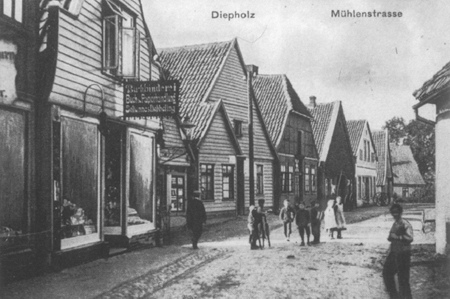
Diepholzer Synagoge 3.Haus seen from the left (hist. Aufn.)
The synagogue district Diepholz formed in 1843 included the towns of Barnstorf, Cornau and Drebber in the community; A few years later, the Jewish families from Goldenstedt and Heiligenloh were also included. Although Barnstorf was not an autonomous community, there was a cemetery on the “Judenberg”.
There should have been lessons for the Jewish children in Diepholz from the end of the 18th century. But there were conflicts between the hired teacher and the church about the organization of the service; Frequent teacher changes were the result and no continuous teaching could be held. Due to the decline in the number of students, the school was completely abandoned in 1924, only religious education was granted until 1932.
The Jewish burial ground northwest of Diepholz was first mentioned in 1774 and 1782 as an “old Jewish cemetery”; i.e. The cemetery grounds must have been used decades before.
Jews in Diepholz:
— 1717 ……………… 3 Jewish families,
— 1824 ……………… 9 “”, * * in the ‘Hausvogtei’ Diepholz
— 1833 ………………. 50 Jews,
— 1845 ……………… 8 Jewish families,
— 1867 ……………… 17 “”, ** ** synagogue community
— 1871 ……………… 48 Jews,
— 1885 ……………… 50 “,
— 1901 ……………… 30 “,
— 1909 …………… approx. 45 “,
— 1912 ……………… 40 “,
— 1926 ……………… 38 “,
— 1935 ……………… 27 “,
— 1939 ……………… 8 “,
— 1942 (Aug.) ……….. no.
Information from: Falk Liebezeit / Herbert Major, On the traces of Jewish history in Diepholz
At the beginning of the 1930s about 30 Jews lived in Diepholz. The fact that Nazi anti-Semitic propaganda had fallen on fertile ground in Diepholz soon became apparent after the seizure of power: Social and economic discrimination pushed Diepholzer Juden to the sidelines.
The tentative climax of the anti-Jewish measures was the 10th of November 1938, which led in Diepholz to massive riots against the Jewish citizens. The interior of the synagogue on Mühlenstraße was devastated almost completely by SA members during the November pogrom; Even a school class under the guidance of her teacher is said to have participated in the riots. Thereafter, the Jewish citizens were rounded up in the palace prison; Before being released the next morning, their homes were demolished. Even the Jewish cemetery in Diepholz was completely devastated during the Nazi era, the tombstones cut short and small, then used as a material for road construction. In the early summer of 1942, the few Jews remaining in Diepholz were deported via Hannover-Ahlem. On July 25, 1942, the “Diepholzer Kreiszeitung” reported in its issue: “Diepholz Jew Free!” At least ten Diepholzer citizens of Jewish faith were victims of the Holocaust.
In 1947, a trial took place before the Verden district court against nine former members of the SA, among them against the former SA-Standartenführer Gustav Quinckhardt from Syke; the riots and synagogue fires took place in various locations in the district of Hoya and Diepholz. Only in a second trial in April 1951 Quinckhardt was sentenced to a 15-month prison term, but was already served by investigation
In the town of Diepholz, Jewish DPs from Bergen-Belsen were temporarily taken to a barracks camp after the end of the war; but due to the inadequate living conditions in Diepholz they returned to the camp Bergen-Hohne. In September 1946, the “Jewish Committee” in Diepholz, chaired by Mordechai Freudenreich, celebrated the reopening of the synagogue; this had been restored by order of the British military authorities. In the 1950s, the private property was demolished. The former location of the synagogue today houses a residential and commercial building. There is a commemorative plaque with the following inscription since the 1980s:
Here, Mühlenstraße 5, stood the synagogue, built in 1835.
This was destroyed by the SA on 10 November 1938, 1946 restored at the expense of the perpetrators, 1952 owned by the Jewish Trust Corporation,
Sold in 1953 due to danger of collapse, demolished and the current living u. Commercial building built.
In the Jewish cemetery in the district Ovelgönne a memorial stone commemorates the small Diepholzer community; whose inscription reads:
In memory of the members of the synagogue community in Diepholz, who have found peace here in this cemetery.
All the unforgettable victims of a time who have died far from home,
where love and respect for one’s fellow man had died
1933-1934
For you we were choking every day.
Outlawed like the sheep at the slaughterhouse.
44. Psalm, 23.Vers
On November 9, 1997, a new memorial was unveiled in the Jewish cemetery; it is composed of fragments of battered tombstones that were previously salvaged during construction (Aufn. Günther Leineweber, from: wikipedia.org, CC BY-SA 3.0).
Since 1980, two streets have been reminiscent of Jewish families whose relatives were deported and killed in extermination camps in a Diepholzer development area: Robergstrasse and Fontheimstrasse.
Around 1700 the very first residence of a Jew in Barnstorf is documented; towards the end of the 18th century, three families lived in the village, trading and slaughtering. In 1801, the first Jewish burial ground was named “Am Judenberg”; but he should have already existed before. As a branch community of Diepholz, the Jews of Barnstorf were able to bring together a minyan with the aid of living families and hold worship meetings until 1829 in a prayer room in the house of the community leader Benjamin Abraham Rosenthal. An allegedly attempted official church planting (around 1840) did not come about. In the course of the 19th century, no more than 20 persons of Israelite faith lived in the village, in 1932 there were 15 “Jewish souls”; Seven years later everyone had left the place.
Twelve tombstones or relics have settled on the small burial ground on the street “Am Rosengarten”
Battle of Diepholz (Napoleonic Age)
http://althistory.wikia.com/wiki/Battle_of_Diepholz_(Napoleonic_Age)
Blog that mentions the Samenfeld butcher shop
http://diepholzerblog.blogspot.com/2014/07/hinterstrae.
 History Of The Samenfeld/Pfifferling Family
Leave a comment