


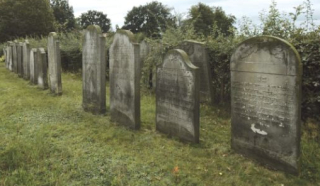
Lavelsloh Jewish Cemetery
This is an article that was written by Muchael Schwarze and published in the Lavelsloh newspaper on March, 2022.
1938 – Die letzte jüdische Familie verläßt Lavelsloh
1938 – The last Jewish family leaves Lavelsloh
The Samenfeld family from Lavelsloh fled Germany in 1938 from the National Socialists. The family had been based in Lavelsloh for several generations.
(English translation below)
Die Familie Samenfeld aus Lavelsloh floh 1938 vor den Nationalsozialisten aus Deutschland. Die Familie war seit mehreren Generationen in Lavelsloh ansässig. Wohnhaft waren sie in der Kirchstraße gegenüber der Apotheke, dort steht heute das Wohnhaus der Familie Plagge. Sie waren Viehhändler und arbeiteten, wie viele jüdische Viehhändler auch, als Metzger. An das Wohnhaus angebunden war eine Scheune, in der das Vieh untergestellt war.

Das Haus der Familie Samenfeld, früher Heynemann. An vierter Stelle von links Dina Samenfeld, geb. Heynemann. Rechts daneben mit Pferd steht Dinas Vater,Isaak Heynemann. Das Bild stammt aus dem Jahr 1894.
Als sie Deutschland verließen, bestand die Familie aus Dina Samenfeld, geb. Heynemann, ihrem Sohn Erich Samenfeld, ihrer Tochter Irma Jacobsohn, geb. Samenfeld mit ihrem Mann Walter Jacobsohn.
Adolph Samenfeld, der Mann von Dina, diente als Soldat im 1. Weltkrieg. Dort wurde er verwundet, als er mit Nervengas in Kontakt kam. Er war Mitglied des "Königlichen Kommandos des Oldenburger Infanterie Regiments Nr. 91". An den Folgen litt er den Rest seines Lebens, die damalige Therapie bestand in der Gabe von Morphium, welches in eine Abhängigkeit führte. Er starb 1933, im Jahr der Machtübernahme Hitlers und wurde auf dem jüdischen Friedhof in Lavelsloh beigesetzt. Die Eltern von Dina Samenfeld, Bertha und Isaak Heynemann, betrieben im Haus an der Kirchstraße schon früher einen Viehhandel, Adolph und Dina lebten nach ihrer Heirat dort und stiegen in das Geschäft ein. Erich und Irma Samenfeld mussten aufgrund der Invalidität ihres Vaters bereits im Kindesalter im Betrieb mithelfen. Sie trieben Vieh auf die örtlichen Märkte, Erich fuhr in seinem Fahrrad in einem großen Korb die schweren Fleischpakete zu den Kunden.
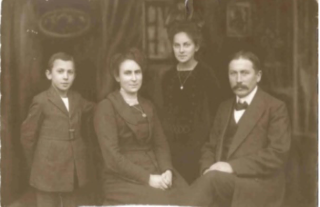
Familie Samenfeld, um 1920
Anfang bis Mitte der 1930er Jahre verschlechterte sich allerdings die Lebenssituation für die Familie. Die Nationalsozialisten entzogen ihnen die Lizenz für den Viehhandel und beraubten sie dadurch ihres Haupteinkommens. Die Familie entschloß sich dann im Jahr 1938, gerade noch rechtzeitig, zur Auswanderung in die USA. Dina Samenfeld hatte bereits einen Bruder und eine Schwester dort, die bei der Auswanderung unterstützen konnten. Dies war Voraussetzung für eine Emigration.
Die Anfangszeiten in den Vereinigten Staaten waren schwierig, Arbeit war auch dort nicht einfach zu bekommen. Walter Jacobsohn fand schließlich Arbeit in einer von Deutschen geführten Schlachterei, Erich Samenfeld absolvierte eine Ausbildung zum Schweißer und arbeitete dann in diesem Beruf. Die Frauen trugen mit Näh- und Strickarbeiten und als Hausangestellte zum Einkommen bei. Später übersiedelten die Familien nach Milwaukee, wo sie wieder ins Viehgeschäft einstiegen.
Nichtsdestotrotz verloren innerhalb der weit verzweigten Familie über 60 Familienangehörige ihr Leben im Holocaust.
Dieser Artikel entstand mit Hilfe des Sohns von Erich Samenfeld, Gary. Über seine Familienwebsite konnte Kontakt mit ihm aufgenommen werden und er erteilte die Erlaubnis zur Verwendung von Texten und Bildmaterial.
Die Geschichte der Familien Samenfeld, Jacobsohn und Heynemann ist natürlich noch sehr viel umfänglicher, vielleicht ergibt sich die Möglichkeit zur Fortsetzung.
Translation:
1938 – The last Jewish family leaves Lavelsloh
The Samenfeld family from Lavelsloh fled Germany in 1938 from the National Socialists. The family had been based in Lavelsloh for several generations. They lived on Kirchstraße opposite the pharmacy, where the Plagge family's house is today. They were cattle dealers and, like many Jewish cattle dealers, worked as butchers. Attached to the house was a barn in which the cattle were kept. The house of the Samenfeld family, formerly Heynemann. Fourth from the left is Dina Samenfeld, née Heynemann. To the right is Dina's father, Isaak Heynemann, with his horse. The picture dates from 1894.
When they left Germany, the family consisted of Dina Samenfeld, née Heynemann, her son Erich Samenfeld, her daughter Irma Jacobsohn, née Samenfeld with her husband Walter Jacobsohn.
Adolph Samenfeld, Dina's husband, served as a soldier in World War I. There he was wounded when he came into contact with nerve gas. He was a member of the "Royal Command of the Oldenburg Infantry Regiment No. 91". He suffered from the consequences for the rest of his life, the therapy at that time consisted of the administration of morphine, which led to addiction. He died in 1933, the year Hitler came to power, and was buried in the Jewish cemetery in Lavelsloh. The parents of Dina Samenfeld, Bertha and Isaak Heynemann, used to run a cattle trade in the house on Kirchstraße. Adolph and Dina lived there after their marriage and got into the business. Erich and Irma Samenfeld had to help out in the business when they were children due to their father's disability. They drove cattle to the local markets, Erich drove the heavy packages of meat to the customers on his bicycle in a large basket. In the early to mid-1930s, however, the living situation for the family deteriorated. The Nazis revoked their livestock trading licenses, thereby depriving them of their main income. The family then decided in 1938, just in time, to emigrate to the USA. Dina Samenfeld already had a brother and a sister there who could help with the emigration. This was a prerequisite for emigration.
The early days in the United States were difficult, and it was not easy to find work there either. Walter Jacobsohn finally found work in a German-run slaughterhouse, Erich Samenfeld trained as a welder and then worked in this profession. The women contributed to the income with sewing and knitting work and as domestic servants. The families later moved to Milwaukee, where they got back into the cattle business.
Nonetheless, more than 60 members of the widely ramified family lost their lives in the Holocaust.
This article was created with the help of Erich Samenfeld's son, Gary. He could be contacted through his family website and he gave permission for the use of texts and images.
The history of the Samenfeld, Jacobsohn and Heynemann families is, of course, much more extensive, perhaps there is a possibility to continue.
 History Of The Samenfeld/Pfifferling Family
Leave a comment