


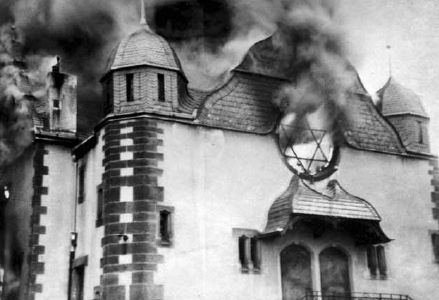
The burning synagogue of Siegen on the morning of November 10, 1938
My mother’s aunt & uncle, Paula (geb Pfifferling) & Julius Rosenberg lived in Siegen.
Siegen:
General information: First Jewish presence: 13th century; peak Jewish population: 130 in 1925; Jewish population in 1933: 122
Summary: Jews first lived in Siegen in the 13th century, but government restrictions prevented large numbers from settling there until the latter half of the 19th century. Siegen’s Jewish school, opened in 1871, was recognized as a public Jewish elementary school in 1886, just two years after local Jews established an official community (in 1884). Services were conducted in prayer rooms located in various family homes—records mention two such rooms on Lindenstrasse and Poststrasse—until July 22, 1904, when the community inaugurated a synagogue on Am Obergraben (the school was moved to the same building). The Jewish cemetery on Lindenberg was consecrated in 1871. From the early 20th century onwards, local Jews, many of whom were livestock traders, butchers and shop owners, were active in the town’s social and political life. A Jewish women’s association and a women’s union conducted charity work in Siegen. The anti-Jewish boycott was enforced in Siegen several months after it was officially announced. In all, 24 Jewish-owned businesses were expropriated during the “aryanization” process. On Pogrom Night, all Siegen’s Jewish men were arrested and sent to the Oranienburg concentration camp, where they were interned for many weeks. On November 10, 1938 (one day after Pogrom Night), rioters burned the synagogue’s furniture and stole the Torah scrolls. By 1939, what remained of the building had been removed, after which an air raid shelter was built on the site. Thirty-nine Siegen Jews were deported to the camps; six local Jewish women who were married to Christians survived the war. A memorial plaque was unveiled at the former synagogue site in the 1960s. In 1978, the entrance to the air raid shelter was converted into a memorial.
Author/Svetlana Frank
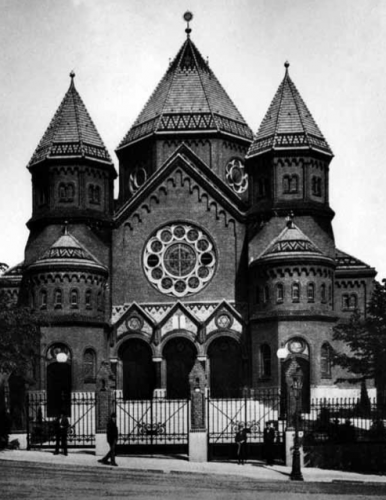
The synagogue of Chemnitz, probably in the 1920s.
My mother’s cousin Charlotte and her family lived in Chemnitz.
Berthold Steinberg (15.7.1903) and his wife, my mother’s first cousin, Charlotte Steinberg (geb. Rosenberg) (22.4.1909), and their daughter Marion Steinberg (16.12.1930). Charlotte was the daughter of my Opa Karl’s sister Paula.
Chemnitz
General information: First Jewish presence: 1357; peak Jewish population: 3,500 in 1925; Jewish population in 1933: 2,387
Summary: The earliest available record of a Jewish presence in Chemnitz is dated 1357. A ban on Jewish residency was announced in 1539, and it was not until the latter half of the 19th century that it was rescinded, as a result of which, during the 1860s and 1870s, Jewish merchants settled in this industrial city. Founded in 1871, the modern community consecrated a prayer hall (on Neugasse) in 1878 and an actual synagogue (on Stephansplatz) in 1899; the Liberal synagogue, built in the Romanesque style, featured a cupola and a seating capacity of 700. Chemnitz was also home to several Orthodox prayer rooms, mainly used by Eastern European Jews. Other communal institutions included a school for religious studies (founded in 1876) and a cemetery, the latter of which was consecrated on Hoher Weg in 1879 and is still in use. Local Jews hired a rabbi in 1881, and we also know that beginning in 1914, the Jewish population grew as Jewish immigrants from Eastern Europe arrived in Chemnitz. After World War I, members of a political organization started arranging anti-Semitic meetings in the city. In 1933, 2,387 Jews lived in Chemnitz. A teacher/ chazzan instructed 155 schoolchildren, and 100 pupils attended the Talmud Torah. A rabbi served the community, which still operated a mikveh and two prayer rooms (on Theaterstrasse and on Feldstrasse). Still active in Chemnitz were 13 Jewish welfare associations, numerous foundations, several local branches of national Jewish organizations and a kindergarten, the last of which was run by the Jewish Women’s League. In March 1933, SA men forced Jews to remove anti- Nazi slogans from buildings and pillars, soon after which, on April 1, 1933, the anti-Jewish boycott was implemented in Chemnitz. Violence erupted, and some Jewish-owned stores were damaged. In October 1938, 300 Polish Jews were expelled from Chemnitz. On the evening of November 9, 1938 (Pogrom Night), SA men and local youths set the synagogue on fire, cheered on by a shouting mob. Jewish-owned stores were looted, windows were smashed and more than 170 local Jews were arrested and taken to Buchenwald. Of these, one was shot, and a few died either during or after their detention. The synagogue was sold in April 1939. The Jewish population figure for that year was 2,096 persons, of whom only a small percentage managed to emigrate from Germany. The remaining Jews were eventually moved into designated Judenhaeuser (“Jews’ houses”) and subjected to forced labor. Between 1942 and 1945, a total of 2,000 local Jews were deported to Riga, Belzyce and Theresienstadt; almost all of them perished in the Shoah. A new Jewish community was established in Chemnitz after the war. In 1988, a commemorative stele and a memorial stone were unveiled, at Stephansplatz and at the Technical University, respectively. A new synagogue was inaugurated on Stollberger Strasse in May 2002.
Author/ Heidemarie Wawrzyn
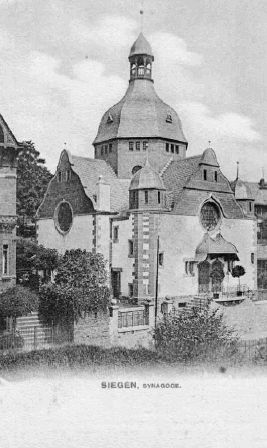
Siegen Synagogue
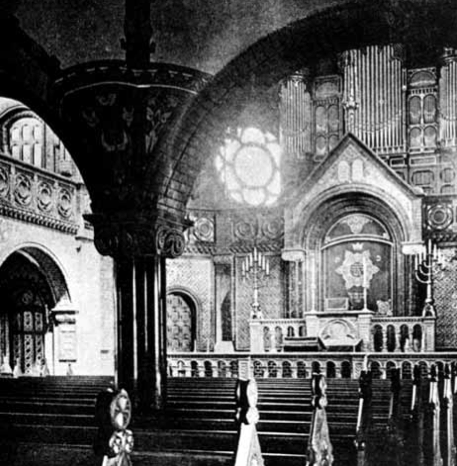
Chemnitz Synagogue
 History Of The Samenfeld/Pfifferling Family