


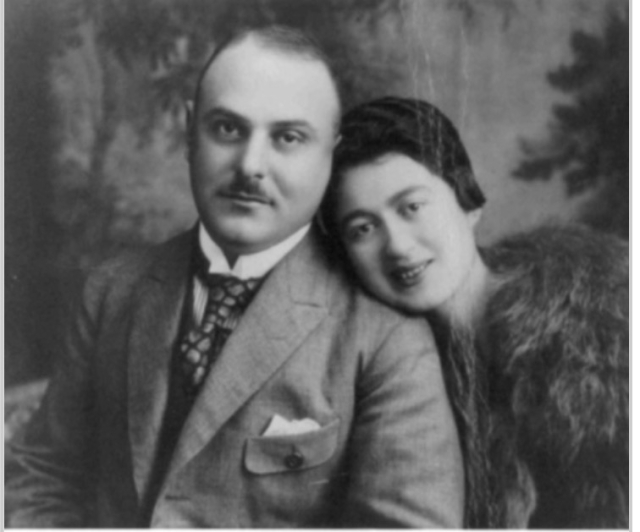
Opa Karl and Oma Julchen Pfifferling
My mother’s parents engagement picture.
From my mother’s story: My parents met in 1921 through some mutual cousins. They were married that year on Oct, 16. They knew each other only 6 weeks before the wedding.
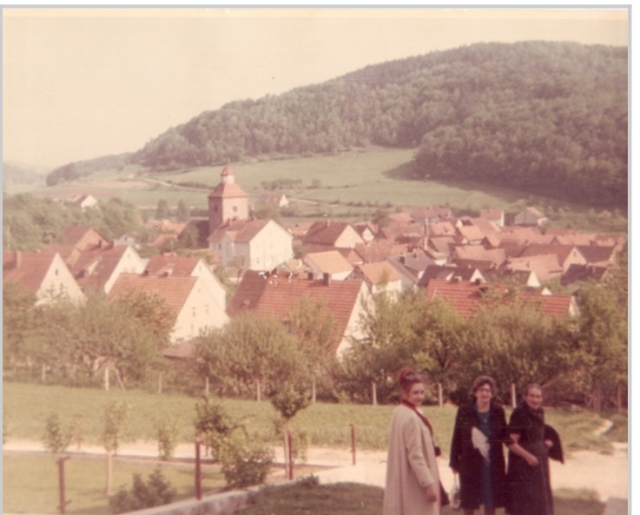
Datterode, Germany
This is the town in Germany where the Pfifferling family was originally from. In my mother’s story, she says that it is near the Fulda River. My mother’s great-great-grandfather, Sander, her great-grandfather, Joseph, and her grandfather, Sander, were all born in Datterode. Joseph and his wife, Jettchen had 13 children. Their house, Brunnenstraße 24, is still known as “the 13-children house”. Opa Karl’s oldest sister, Meta, and older brother, Adolph were also born in Datterode. The family then moved to Wanfried, and then again to Halle/Saale. The woman in the center at the bottom of this picture is Opa Karl’s cousin Hilde Frank, who was born in Datterode and lived in Evanston, Illinois. Hilde’s father, Albert Pfifferling, and Opa Karl were first cousins.This picture was taken when Hilde visited Datterode in 1969. The other two women are Hilde’s sister Ilse Pfifferling, who emigrated to Argentina, and Christine Ronshausen, who lived in Datterode. Thomas Beck of Datterode identified them for me.
Jews of Datterode:
http://www.heimatverein-datterode.de/en/our-village/datterode-jews/let-us-not-forget
Photos: Opa Karl’s first cousin, Albert Pfifferling, and Albert’s daughter, Hilde Frank.
copy & paste
http://data.synagoge-eisleben.de/gen/fg05/fg05_452.htm
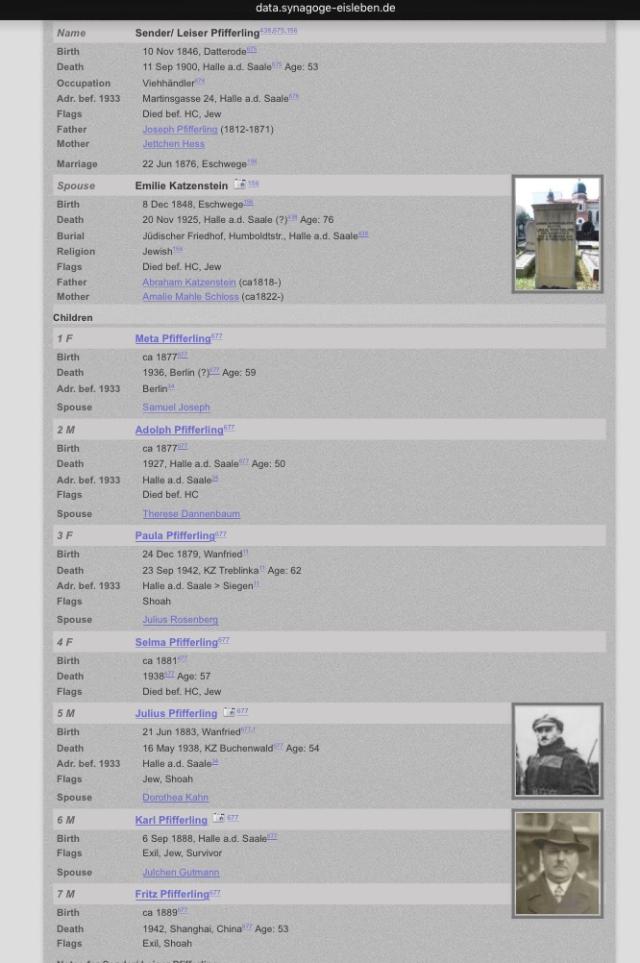
Sander Pfifferling & Emilie (geb Katzenstein
Graphic of the Pfifferling family tree provided by Sebastian Funk / Leipzig, Germany:

Julius & Dorthea (Kahn) Pfifferling
My mother’s uncle Julius was killed in the Buchenwald Concentration Camp in 1938. He was shot to death while running into the electric fence. This was witnessed by a cousin of Opa Karl, (Alfred Wertheim). His wife Dorthea emigrated to England. She died in 1952.
From the Memorial Book for the Jews of Halle/Saale, courtesy Heidi Bohley
Julius (“Jule”) Pfifferling, born on June 21, 1883 in Wanfried / Hesse served as a German soldier in the First World War. His niece Hildegard Samenfeld (Karl’s daughter) described him as a friendly, gentle person who liked to meet with friends in a nearby pub for playing cards. In 1933, the livestock business was excluded from the “Central German Association of Horse Trade” and after the prohibition of occupations in 1937, the brothers Pfifferling had to stop the cattle trade. On April 25, 1938, Julius Pfifferling was among the 13 Jews from Halle who were arrested as part of the “ASR Action” and sent to the Buchenwald concentration camp. These arbitrary arrests served as a deterrent and were intended to encourage other Jews to leave Germany. Julius Pfifferling received the prisoner number 2870 in Buchenwald and had to work in the quarry. Three weeks after being admitted to the camp, the 54-year-old was allegedly shot “on the run” on 16 May 1938.* The police handed the family its urn and let it pay for the cremation costs. Since an urn burial on Jewish cemeteries is traditionally not provided for, the community has created a special grave facility for the unfortunate at the Jewish Cemetery Dessauer Straße.
*The camp was surrounded by a barbed wire fence with 22 watchtowers at intervals, decked with floodlights and guns: the fence itself was 3 meters high and electrified, with a lethal 380 volts running through it. The outside of the fence was patrolled by sentries, and within was a sandy strip called the “neutral zone”: any prisoner stepping on it would be shot.
From the website for the Stolpersteine: Halle/Saale
(click the image for Franckestrasse 12) https://translate.google.com/translate?hl=en&sl=de&u=http://www.zeit-geschichten.de/th_01a.htm&prev=search
http://garysam.typepad.com/history_of_the_samenfeldp/2013/06/k.html#more
http://garysam.typepad.com/photos/julius_pfifferling_trippi/index.html
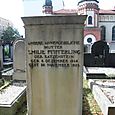
Emilie (geb Katzenstein) Pfifferling
This is the gravestone of Opa Karl’s mother at the Jewish cemetery in Halle an der Saale. Emilie was born in Eschwege, and was the daughter of Abraham & Mahle (Schloss) Katzenstein. The photo was sent to me by Sebastian Funk of Leipzig, Germany.
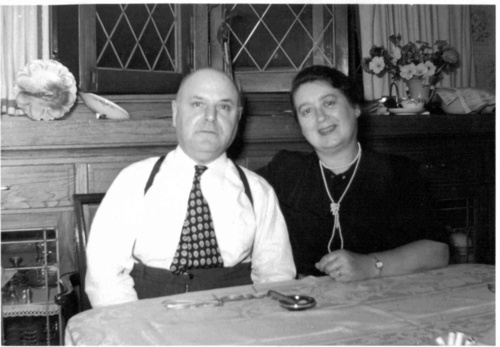
Opa and Oma; August, 1950
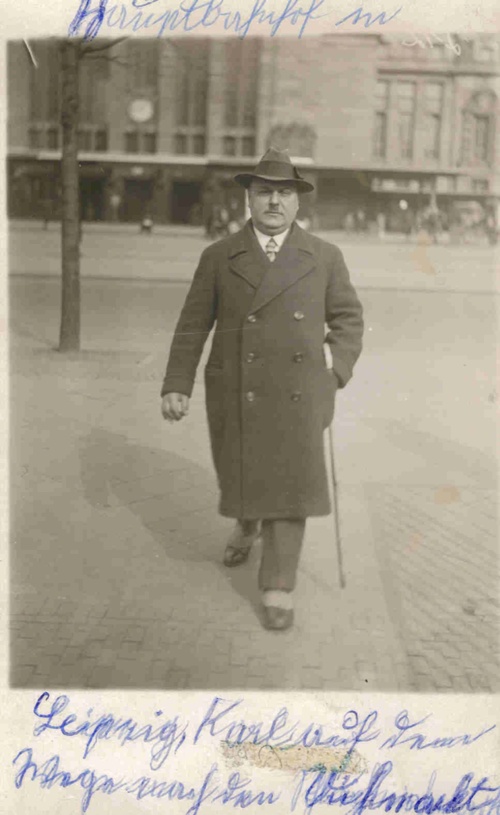
Opa Karl Pfiferling
This picture was taken in Leipzig.
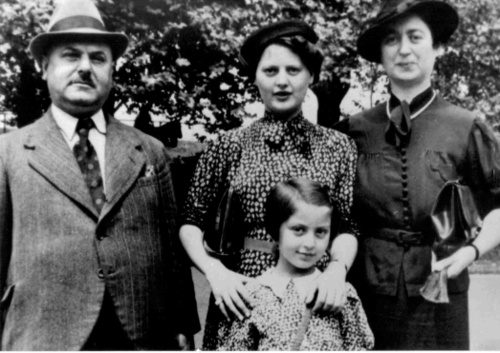
The Pfifferlings.
This picture was taken in Central Park, New York City in August 1939. Opa Karl, My mother Hilde who was 16, Oma Julchen, and Tante Lore who was 8 years old. This photo is quite a contrast from the other family picture in this album that was taken as they were leaving Germany.
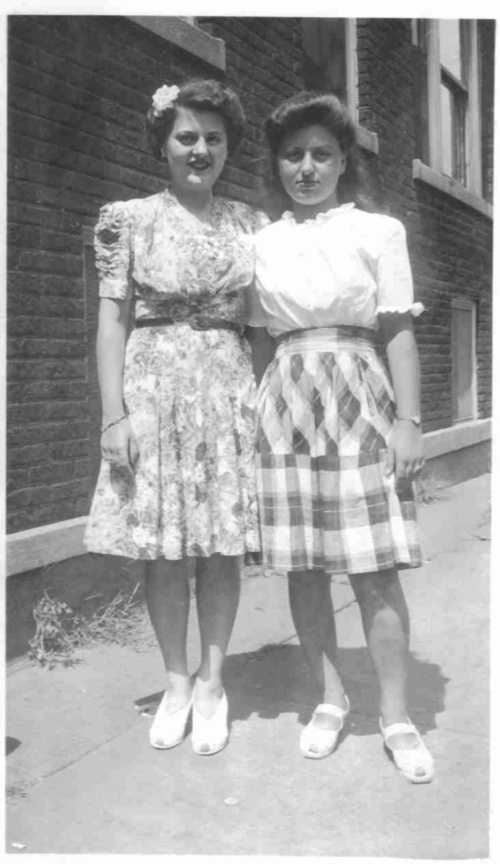
The Pfifferling Sisters
My mother Hilde with Tante Lore.

Tante Lore with me, 1952.
Holton St. & North Ave. Milwakee
My Tante Lore told me two stories that I feel are very important. When my mother’s family came to Milwaukee and settled on E Kane Place they did not speak English and were also quite poor. My Aunt got to go to overnight camp at Camp Sidney Cohen, which was an overnight camp for Jewish children. She went to camp as a hardship case. Tante Lore said that Oma Julchen sent her to this camp with her belongings in a shopping bag. She didn’t have nice clothes like all of the other girls. Like I’ve already mentioned at the time she spoke no English. The other kids all picked on my Aunt and made fun of her. It makes me very angry to think that these were other Jewish children and they had no compassion for my Aunt. It seems that they did not care that my Aunt Lore had suffered through hardships and was lucky to be alive.
As I mentioned above, the Pfifferling family lived on Kane Place. The closest elementary school was Holy Rosary, which was a Catholic school. My Opa and Oma took my Aunt Lore there because they just thought it was the closest school, so that’s where she should go. My Aunt Lore told me that she learned English from the nuns. When my grandparents realized that this was a Catholic school they enrolled her at Maryland Ave. School. Years later my cousins, Peter and Harold Jacobsohn, and myself also went to Maryland.
My mother Hilde with Tante Lore.
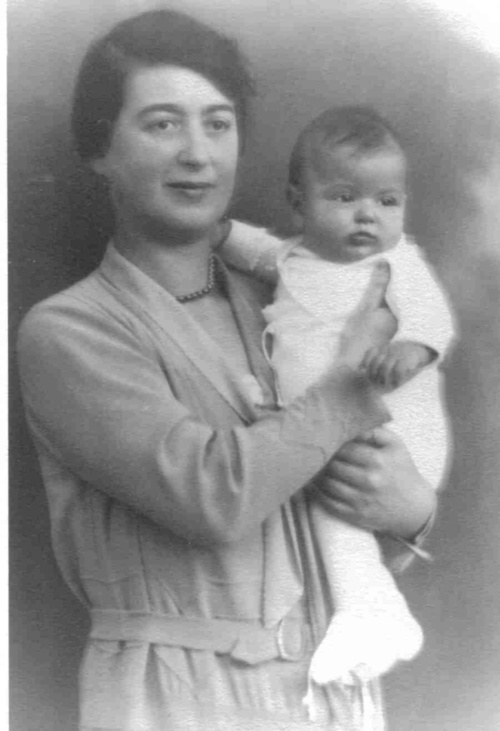
Oma Julchen
My grandmother, Julchen Pfifferling, with my mother.
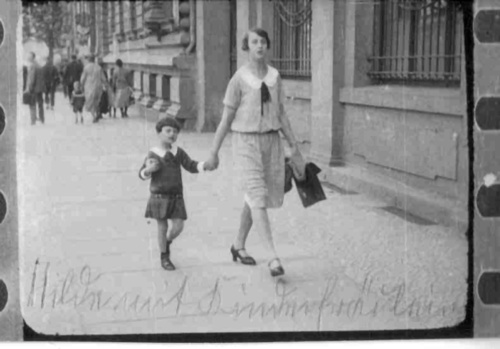
My mother in Halle.
This is my mother with the woman who took care of her when she was a little girl. The one that she referred to as “Meyer the shrier.”
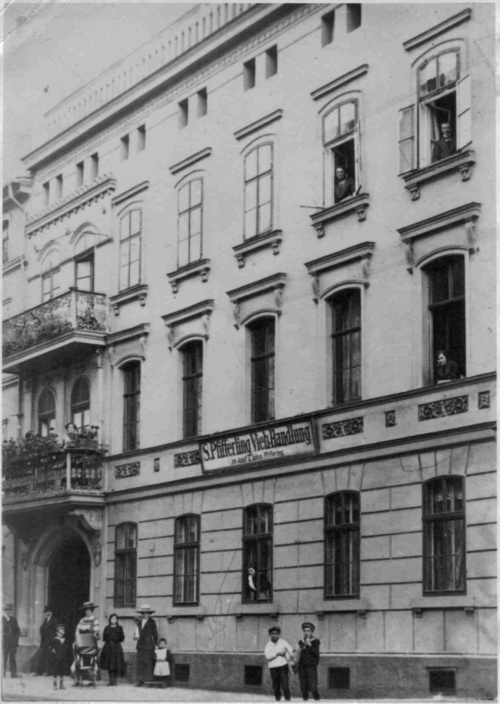
Franckestrasse 17
This is where the Pfifferling family lived in Halle a/Saale. The sign on the building, S. Pfifferling Veihandlung, is the name of the cattle/livestock business of the four Pfifferling brothers. The S on the sign is for their father, Sander. The brothers were my Opa Karl, his two older brothers, Adolph, and Julius, and Opa’s younger brother, Fritz.
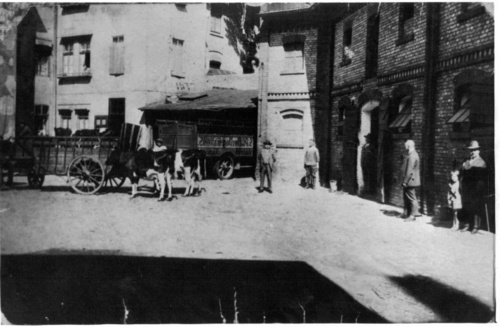
Franckestrasse 17, Rear
This is where my Opa Karl and his brothers had their cattle business. My mother and Opa are on the far right in this photo. My mother made the X on the picture.
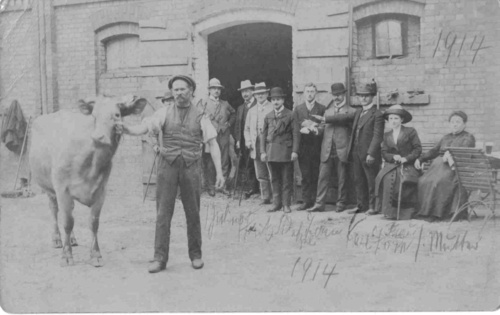
Pfifferling Brothers 1914
Opa Karl Pfifferling is standing on the far right of this picture. Opa’s mother Emilie Pfifferling is seated on the far right. His brother Jule is on the left side of the door, and Fritz is next to the right side of the door.
copy & paste:
http://data.synagoge-eisleben.de/gen/fg05/fg05_430.htm
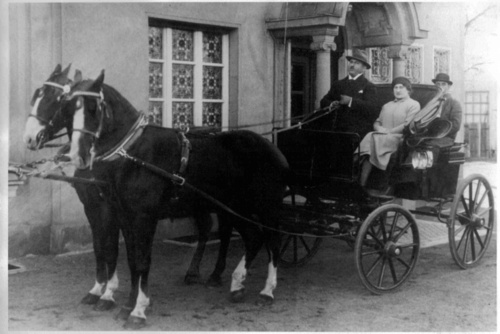
Adolph Pfifferling
This is a picture that my mother had framed in the living room of her apartment. This is her uncle and aunt, Adolph and Therese Pfifferling. Adolph was my Opa Karl’s oldest brother.
copy & paste:
http://data.synagoge-eisleben.de/gen/fg05/fg05_428.htm
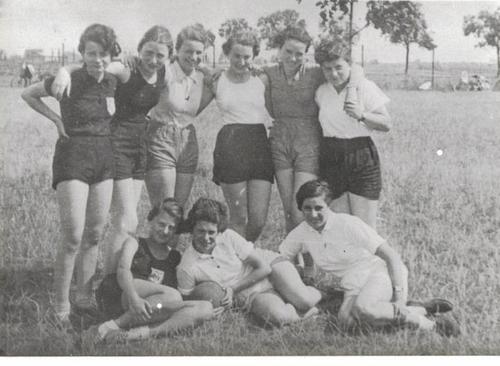
My mother and friends.
My mother Hidegard Pfifferling. She is seated in the front on the left side. This picture is of a sports club that was for young Jewish women. My mother always had this photo in a frame on her bedroom dresser. It must have meant a lot to her.
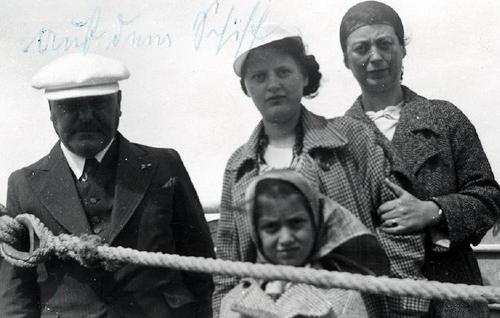
My mother’s family.
This picture was taken on the ship that brought my mother’s family to America. As I mentioned in my speech, it was the last German boat that took Jews out of Germany, and my grandmother feared that the boat would turn around and take them back to Germany.In the foreground is my Aunt Lore, who was 8, then from left to right is my Opa Karl, my mother Hildegard, and my Oma Julchen. The looks on their faces speak for themselves.
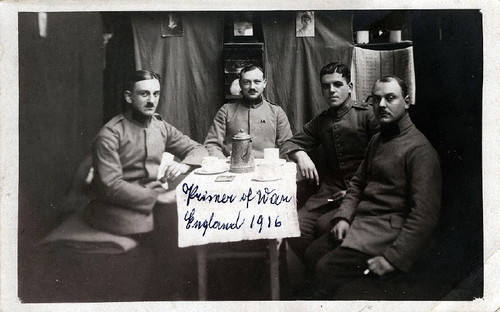
Opa Karl Pfifferling: World War I
My mother’s father is on the far right in this picture. In 1916 my grandfather was taken prisoner of war and was sent to Manchester, England. He was there for the duration of the war.
 History Of The Samenfeld/Pfifferling Family